 |
|
  |

|
 |
|
|
Criminal Law Links: Main page About the law Articles FAQs Fees Lawyers And... Other areas Reference links |
|
|
|
||
Law & Order. LA Law. Street Legal. Presumed Innocent. These are pictures of the criminal justice system which we have from TV. The reality is somewhat different...

Presumption of innocence In Canada, people are presumed innocent until they are proven guilty in Court.. Our whole system of criminal law works under this principle and it effects many different aspects of our criminal law system. Top of Page Right to remain silent You've heard the police say on TV, "You have the right to remain silent. Anything that you say may be used against yourself." It's true. If you are accused of a crime, you're not required to say anything to the police other than basic information required by the police to identify you. There are some exceptions to this general rule. For example, refusing to take a breathalyzer test is a specific criminal offence. Top of Page Proof beyond a reasonable doubt There is a maxim that it is better that 10 guilty men go free than one innocent man be wrongly convicted. In court, the crown prosecutor will present evidence that you committed a specific criminal offence, and must prove its case "beyond a reasonable doubt". It's not enough to show that there's better than a 50/50 chance that you did it, or even a 60/40; the test is beyond a reasonable doubt. Your lawyer will challenge this evidence to contradict the crown's case. He or she doesn't need to prove that you didn't do it; he or she just needs to raise a "reasonable doubt" as to the crown's case. Like O.J. Simpson, you don't have to testify to prove your innocence; you can just attack the crown's case. Top of Page Due process You also have the right to "due process". That means that the police and the crown prosecutor must abide by your constitutional rights when they gather evidence and present your case to the court. If the police illegally invade your privacy or property in order to gather evidence against you, they may not be able to use in court against you. Top of Page Kinds of criminal offences There are two types of criminal offences: summary conviction offences and indictable offences. Summary conviction offences are less serious, and generally have a maximum sentence of a $2000 fine and up to eighteen months in jail. These are usually dealt with in Provincial Court which is the lower level Court in British Columbia. Indictable offences are more serious, and can have penalties as high as life imprisonment. These offences may be heard in Supreme Court or Provincial Court, and may be heard by a judge and jury, or else a judge alone. Top of Page |
||||||
More questions? Home | About Us | E-mail Us | Site Map | Areas of Law | What's New Top of Page |
||||||
|
Legal disclaimer: The information provided on Lawyers-BC.Com is not intended to be legal advice, but merely conveys general information related to legal issues commonly encountered. Your access to and use of this Web site is subject to additional terms and conditions. This page last updated: December 3, 1999 © copyright 1999 Lawyers-BC.Com Services Ltd. See Sponsor Link CanadaVisaLaw.com for Canada Immigration & Business Lawyers, Lowe & Comapny in Vancouver, BCBusiness & Investor Immigrants | Intra company Transfers | NAFTA work visas-permitsSee Sponsor Link Class Action lawyers in Vancouver, BCIncluding Product Liability | Medical & Professional Negligence |See Sponsor Link Personal Injury - ICBC claims lawyers directory in Lawyers-BC.comExperienced trial lawyers speaking: English, Cantonese, Mandarin, Polish, Vietnamese, Russian and German, Gujarati, Hindi, Swahili & Khutchi - with experience in USA cross border cases, UK and Canada trainingSee also Vancouver Lawyers | Victoria lawyers | Nanaimo lawyers | Edmonton lawyerssponsor-admin 2004/02/01 www.netpac.com email sponsor ad links |
||||||
CRIMINAL LAW INFORMATION SPONSORS
Serving Metro Vancouver - Surrey, B.C. & King County, Washington State
|
York Business Park # 205, 12888-80th Avenue Surrey, B.C. Canada, V3W 3A8 Phone: 604.598.1118 E-mail: WABCLawyers@aol.com Web site: www.GosalLaw.com |
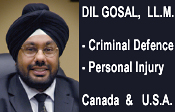
- see Dil Gosal's lawyers profile
- read his article on the difference between sentencing for drug trafficking in Washington State vs B.C.
- visit his web site www.GosalLaw.com
- read his article on Canada's criminal court system
- read his artilce on the What is USA Grand Jury - Court system About
Dilraj (Dil) Gosal, BA JD LLM
Criminal Defense & Personal Injury Lawyer Represents Clients For:
- Aggravated assault
- Attempted murder & Murder charges
- Criminal Negligence
- D.U.I.
- Motor vehicle / car accident personal injuries I.C.B.C. insurance claims disputes
Contact Dil Gosal at:
York Business Park
# 205, 12888-80th Avenue
Surrey, B.C.
Canada, V3W 3A8
Phone: 604.598.1118
E-mail: WABCLawyers@aol.com
Serving Victoria - Capital Region District & Southern Vancouver Island
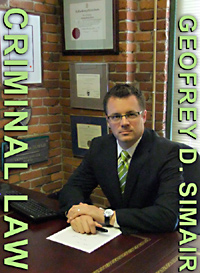
GEOF SIMAIR, Preferred area of practice: criminal law |